Monday, May 23, 2011

BROCKEN SPECTRE...

Those who love mountain climbing may have observed a strange and startling phenomenon: a shadowy, almost ghostly outline of a person magnified by a misty halo around it. This seemingly supernatural experience is called a Brocken Spectre or a Brocken Bow - a climber standing in front of a low sun on a ridge or peak on a misty or foggy day.
Though a Brocken Spectre may appear huge because of fog and the glory obscuring its dimensions, it is merely the shadow of a person seen in the mist – usually one’s own – converging toward the antisolar point and coinciding with a glory (a rainbow-coloured halo produced by light backscattered through a cloud of water droplets).
To see a Brocken Spectre, specific weather conditions need to be met: the observer must be with his or her back toward the sun, for example in high-mountain areas where the sun is low. Many water droplets must be suspended in the air where the Spectre's glory appears. Through diffraction, sunlight reflects off water droplets and shines back toward the sun and the observer, in these cases even two or more:
By the way, the name of the phenomenon is not a misspelled version of “broken spectre” but refers to the German mountain the Brocken, the higest peak of Germany’s Harz region. The Brocken is also the place where on Walpurgisnacht, witches are said to congregate in high numbers.
The Brocken Spectre was observed and first described by theologian and natural scientist Johann Silberschlag in 1780. Since then, several records of the phenomenon have been kept in regional literature about the Brocken.
But the phenomenon is by no means restricted to Germany; Brocken Spectres have also been observed at many moutainous regions Ireland.The photos above were taken in the mountains of Kerry and Waterford.

Thursday, May 5, 2011

1943 Crash of USAAF "Dakota"" on Cnoc na Péiste...

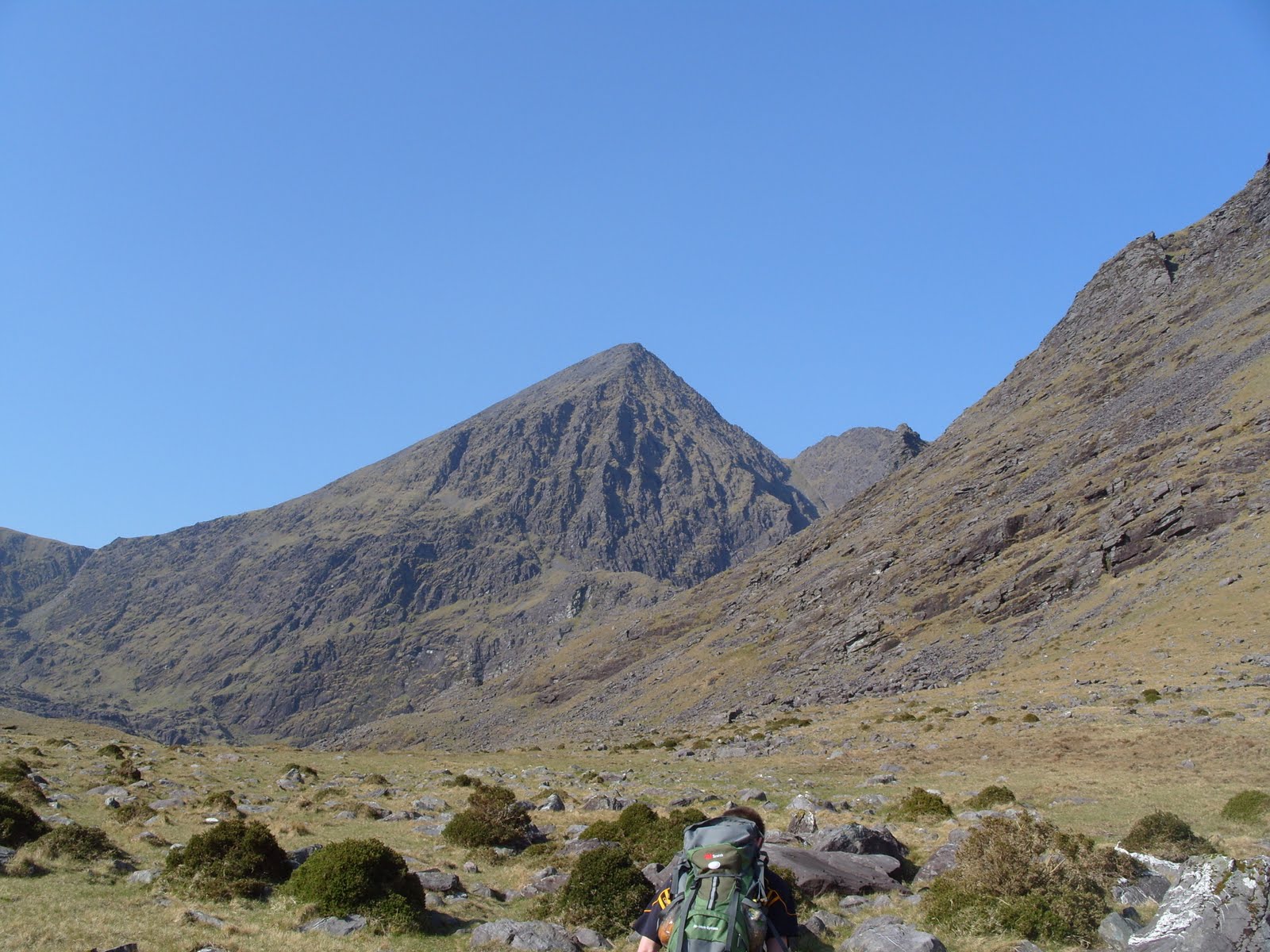
Very many people climb to the summit of Ireland’s highest mountain, "Carrantuohill', at 3,414 ft. But few realise that while many have died trying to reach the summit, five Americans lost their lives on a nearby summit during World War Two.

This particular Aircraft, the C 47, was the military version of the famous DC3 or in British terms "The Dakota". It was brand new when the United States Army Air Corps took delivery of "43-30719" in June 1943. It was built by the Douglas Corporation at Long Beach, California at a cost of $109,000.

The winter route for this C 47 was from the USA to England on a ferry flight in preparation for D-Day, was from Morrison Field - West Palm Beach, Florida to St. Eval - Cornwall via British Guiana and Dakar in West Africa to Port Lyautey in French Morocco. At Port Lyautey, the C 47 refueled and took on a cargo of Battle Bicycles (this will be explained later) and medical supplies, but contrary to other official reports, no nurses were on board.

The crew comprised of the following (TCG-Troop Carrier Group), 2nd Lt. John L. Schwarf (Pilot) of San Ardo, California (63rd TCG). 2nd Lt. Laurence E. Goodin (Co­pilot) of Springfield, Ohio (63rd TCG). 2nd Lit. Frederick Brossard (Navigator) of Washington DC. (437th TCG). Staff Sgt. Arthur A. Schwartz (Engineer) of Wilmington North Carolina (Army). Staff Sgt. Thomas L. Holstlaw (Crew Chief) of Luka, Illinois (Army).
                .
The Aircraft took off at 10.30pm on the 16th of December, 1943 from Port Lyautey for St. Eval in Cornwall. The routing would be mostly over water and strict radio silence had to be maintained over 'The Bay of Biscay' where Luftwaffe Junkers JU88's were on heightened alert.

Our C 47 was accompanied by four other C 47s. A course change was due off Cape Finnestere in Northern Portugal but our C 47 never made it. But continued in a Northerly direction and at approximately 6.00 am on the morning of the 17thof December, 1943 and in total darkness the C 47 arrived over the Dingle Peninsula. In order to locate where they were, the aircraft dropped altitude to approx. 2,000 ft. Not realising they were in an area of 3,000Ft summits, The Brandon and the McGillycuddy Mountain Ranges in its immediate vicinity. I suspect that the crew may have confused the Dingle Peninsula with South West Cornwall.

At approximately 7.00 am, the aircraft slammed into the ridge above Coomena Peasta Lake at an altitude of 2,000ft. Four of the crew died instantly. Staff Sgt. Arthur Schwartz, a man of 16 stone crawled away from the ensuing fire and died wedged between two rocks.

Should the story end there, I think not!
Many historians will tell you that the aircraft crashed on the 3rd of February, 1944. This was the story told at the time and historians carried it forward until 1981, than I began my research. After three years of difficult groundwork I surmised a local person returning home from an all night card game, observed something on fire high up on the mountains on 17thrdof December, 1943. He told his neighbour and both persons "visited" the crash site on St, Stephen's day, the 26thof December, 1943. They would have seen the charred remains of the crew inside the still smoldering aircraft. They too would have seen the body of Staff Sgt. Schwartz wedged between the rocks, the only injury observed would have been his scorched back. They would have seen the gold ring on his wedding finger and they certainly saw the Battle Bicycles.

These bicycles were to be used by the 101st Airborne Division (the Screaming Eagles) of the American Army. They were to be parachuted behind enemy lines in German occupied France on the 6thof June, 1944; the smoldering fuselage and bodies were looted.

Finally on the 3rdof February, the Gárda Síochána in Beaufort were notified, and they in turn contacted Army Brigade HQ in Limerick. On the morning of the 4thof February, 1944 a detachment of the I5th Inf. Btn. from Ballymullen Barracks in Tralee arrived at Mealis and walked to the crash site. The recovery of the victims was dangerous. Some of the Army Party were led to believe that the Aircraft crashed on the 3rdof February, 1944 and indeed all future crash reports carried that date. The five bodies were coffined at the GorthBee Youth Hostel and they were brought to the Town Hall in Killarney where an inquest was held on the 6thof February, 1944. The five coffins draped in the "Stars and Stripes" were buried with full military honours in the New Cemetery Killarney. However in June 1944, the coffins were exhumed and reburied in the GI Cemetery near Belfast.

In 1946 the coffins were exhumed again. The bodies of 2nd Lt.s Schwarf, Goodin and Brossard are interred in the U.S. Military, Cambridge, England. While Staff Sgt. Holstaw was reburied in Luka, Illinois alongside his mother. His father Thomas died in 1947 of a broken heart. Staff Sgt. Holstlaw was an only child.

Staff Sgt, Schwartz was reburied in Beni-Israeli Jewish Cemetery in Wilmington, North Carolina.
 A memorial ceremony was held at Cronin's Yard, Mealis, Beaufort on the 19thof August, 1984 in the shadow of the crash-site. The then US Army Defence Attaché of the American Embassy "Colonel Carl Finstrom" unveiled the memorials.


 Cnoc na Péiste from the shore of the lake. Blue arrow indicates the location of a blue rope which is tied to the wing in the water (and to a rock on the other end). No use pulling it: the wing is too heavy. The red arrow shows the location of a memorial plate. The plane crashed into the mountain 500 feet above this plate


Extracts taken from an essay by Ger. O'Regan and also Mountainviews.ie

Monday, April 25, 2011

A less risky route to the roof of Ireland...

The Irish Times Saturday, June 26, 2010 

JOHN G O'DWYER
 Ireland’s highest mountain has been made safer by the construction of a bridge in the Hag’s Glen – and increased co-operation between those who own the land and those who use it for recreation
IT WAS A benign morning about 20 years ago when our walking group left for the summit of Carrauntoohil from the traditional starting point at Cronin’s Yard in Mealis, Co Kerry. The going was good as we tripped over the stones in the River Gaddagh and headed upwards on what seemed a perfect day.
The mountain had other ideas, however, and as we neared the top it enveloped us in a torrential rainstorm and buffeted us with angry gusts that seemed about to take the earth from beneath us. Waving the white flag on our summit ambitions, we retreated to the Gaddagh but found that the gentle stream of earlier was now a raging waist-high maelstrom. Our only option was to pendulum across while attached to a rope held by someone farther up the bank of the stream.
The first person in was immediately knocked over, and would have been carried away but for the rope lifeline. Everybody eventually made it across, but it had been a close call, and we knew we had been lucky. Not so lucky was a Limerick doctor who was swept to her death while crossing the river in 1987 and is now remembered on one of a series of poignant plaques in Mealis commemorating those who have perished on Carrauntoohil and the surrounding uplands.
THE HAG’S GLEN , which lies above Cronin’s Yard, is well known as the prime black spot for mountain accidents, not only because of the large number of hillwalkers attracted by Ireland’s greatest concentration of five-star peaks but also because of its complex and unforgiving terrain. For a long time it has been recognised that remedial safety work on the Carrauntoohil trail that passes through the glen was badly needed, particularly at the crossing of the Gaddagh. The area is mostly in common ownership, however, and until now there has been no consensus about the safety measures that were required.
John Cronin, who runs a cafe for climbers at the gateway to the glen, believes previous initiatives failed because farmers were not adequately consulted, but this mistake is not about to be repeated. He says recent efforts by South Kerry Development Partnership – particularly its rural recreation officer, Maria Farmer – have been crucial in achieving a new consensus for the area. “She has succeeded in bringing all interested parties on board for the first time, and the result is a scheme that could see the Hag’s Glen become one of Ireland’s best outdoor amenities,” says Cronin.
The scheme that Cronin refers to is one of two pilot initiatives nationwide – the other is at Clonbur, Co Galway – which operates under the remit of the newly inaugurated Mountain Access Scheme. These initiatives are aimed at kickstarting an era of responsible recreation in high mountain areas. The objective is to put aside the rancour and bitterness that have bedevilled upland access for more than a decade and instead develop a consensus based on mutual respect between landowners and recreational users. This approach contrasts sharply with a legislation-backed general right to roam that has been adopted as the model in other jurisdictions, including Britain.
Already, a safety dividend has emerged from the Hag’s Glen initiative, with accidents now unlikely at the main river crossings. With support from the landowners, two footbridges, sponsored by the Killarney-based crane company Leibherr, have been built over the Gaddagh and a tributary stream by Kerry County Council.
Cronin is particularly pleased with this initiative. “The footbridges mean the Gaddagh is no longer a safety issue. Walkers now have parking and toilet facilities before they set out for Carrauntoohil, a safer walk to the summit and the comfort of a shower and food when they return. It’s a much better package and far more likely to attract tourists,” he says.
But what about walkers who are not about to tackle our highest mountain? According to Cronin, all levels of walking will be catered for. “A loop walk is presently under construction that will allow low-level ramblers and families a unique view of the great cliffs and ridges on the northeast face of Carrauntoohil.”
Maria Farmer will be responsible for implementing the Mountain Access Scheme in the Hag’s Glen. She is quick to say there is no monetary reward for farmers under the pilot scheme and that the project is built around understanding and goodwill. “Landowners in the Hag’s Glen have always welcomed walkers and allowed unrestricted access for generations. They are happy to continue doing so, provided their main concerns are met, but in the past these were not given due respect.”
Insurance is the farmers’ principal worry, and this is being addressed under the pilot scheme, with landowners now indemnified against actions arising from walkers or other leisure users. “Dogs are also a problem, as are irresponsible visitors who fail to abide by the country code,” says Farmer. “We are now addressing these issues, and we will be erecting signage with information on responsible walking at the access points to the glen.”
DAVIE O’CONNOR, WHO earns his living farming in the Hag’s Glen, is surprisingly sanguine about the increasing numbers of walkers passing through his land. “All my life we have allowed walkers access, and we are happy to go on doing so once they behave responsibly,” he says. He will continue to provide this access without compensation, but he welcomes the recent spending on facilities at Lisleibane. This includes the resurfacing of the access road, and the new car park. “Up to this we had parking all over the place – in the fields and blocking gates,” says O’Connor. “Most walkers now create no problems for us whatsoever.”
Every mountain is, of course, a work in progress, and the increasing footfall has also created new problems at the Devil’s Ladder, which lies at the head of the glen. This mountain gully, which has traditionally been used as a main access route for Carrauntoohil, has in recent years become dangerously unstable. Cronin believes that with the new accord emerging locally this gully will be the target for the next phase of the pilot scheme, “making Carrauntoohil even safer again for walkers”. In the meantime, he urges visitors to consider using the many other fine routes leading to the roof of Ireland.
On the evidence of the Hag’s Glen, the Mountain Access Scheme appears a laudable departure that has gone a considerable way towards developing a consensual model for responsible recreation in the Irish uplands. If, in time, agreement can be reached on rolling out the scheme nationwide, it clearly has considerable potential for proving the ancient adage that fine things happen where men and mountains meet.


Saturday, April 16, 2011

Birds of the Irish mountains

The Chough...
The chough is a member of the crow family of birds. The species in Ireland are the Red billed Chough (Pyrrhocorax pyrrhocorax). Their closest relatives outside the genus appear to be the jackdaws of the genus Corvus.
The choughs have black plumage and brightly coloured legs, feet, and  red bills, and are resident in the mountains and wind swept coastal regions of Ireland giving rise to the name ‘sea crow’  They have long broad wings and perform spectacular aerobatics accompanied by sharp "chaaow" calls. They pair for life and display fidelity to their breeding sites, which are usually caves or crevices in a cliff face. They build a lined stick nest and lay three to five eggs. They feed, usually in flocks, on short grazed grassland, taking mainly invertabrae prey, supplemented by vegetable material or food from human habitation, especially in winter.
The main threat to this genus is changes in agricultural practices, which have led to local population declines and range fragmentation.

Tuesday, April 5, 2011

Crotty's Rock...

Coum Gabthartha is better known as Crotty's Coum. William Crotty was a famous Waterford highwayman who was hung, drawn and quartered in the city in 1742.
His life as a highway robber was not a solitary one. He was married and was the leader of a gang of highwaymen who operated in the Co.Waterford area and whose exploits took him into the heart of Waterford City (20 miles away). His "hideout" was said to be near the foot of the cliff overlooking the lake. Access to the "hideout" was gained only by a rope which was thrown over the cliff face.
He also, as the tale goes, frequented a local tavern at Dá Rue's Cross now owned by the Hehir family and descended from his mountain home only to steal from the passers by (always rich) and gave the money to the impoverished people of the area.
Indeed the legend runs that Crotty hid his loot under a rock on the mountain with a special mark but was unable to collect because of his capture. The actual destiny of this bounty is still a mystery.
Crotty's demise is a famous one. After evading capture for many years with a sizeable bounty on his head, through shoeing his horse backwards and throwing the Redcoats off his routes he was betrayed by one of his friends, in fact his closest assistant. His home, a cave in the cliff above the lake, was hidden away from the view of the soldiers which searched for him.

So frustrated were the patrols charged with his capture that they gave up chasing him and employed the services of Crotty's long time companion, a man by the name of David Norris. After having a meeting with Crotty at the cave, he waited till Crotty was asleep and after wetting the highway man's gunpowder betrayed Crotty to the Army who made their arrest on February 16th, 1742. When the Waterford Assizes opened on the 17th of March the most important case before them was that of William Crotty. The sentence of Crotty swiftly followed and his execution and subsequent exhibition (Crotty was hanged, and quartered, his head cut off and fixed to the County Goal as a warning to similar malefactors) in Waterford city is detailed below.
After Crotty's death the authorities hunted his wife and she is reputed to have thrown herself and her child off the top of the cliff bearing his name, to her death.

The following appeared in a book "Ireland Sixty Years Ago," published in 1849.

"After Crotty was decapitated pursuant to his sentence, and his head was placed on a spike over the gate of the county gaol, which was at a great thoroughfare, and often a resting place for those who brought milk to the markets. In a few days, the head became in a state of putrid solution, and began to distil drips of gore into the milk cans, for some time before it was discovered, to the inexpressible horror of all those who had been drinking the milk. The hair did not decay with the flesh and grew on the bony cranium; and there for a long time the ghastly skull of this miscreant excited as much horror after his death as his cruel actions during his life.
When a criminal was executed for an offence for which his body is not liable to be given to the surgeons for dissection, his friends were allowed to take it. It was washed and then laid on a truss of straw in a public street, with or without a head, and a plate was laid on the breast, with a halfpenny on it, as an invitation to passengers to contribute to the funeral. It formed sometimes a solemn spectacle, with the felon's widow at the head, wailing, with dishevelled hair and singing, in a low dismal chant, her lament: his children ranged at the feet. But the utter indecency with which the executions were then accompanied, sometimes occasioned the most revolting and horrible scenes.
About the same time at which the abominable occurrence above mentioned of Crotty's head took place, three highwaymen, Stackpole, Cashman and Heirly, were hanged in Waterford. Their bodies were given to friends and were brought to the fish-house, to be washed. While in the act of being washed, the bell rung to intimate a fresh arrival of fish; their bodies were hastily removed from the boards which they occupied, and the fish were thrown down in their place, swimming in the loathsome washings and the blood of the corpses. They were then exposed on the straw in the street and an elderly gentleman, who communicated the circumstances to us, was brought by his nurse to see them, as a sight worthy of contemplation."

Wednesday, March 23, 2011

17th of April ..."MOONLIGHT IN THE MOUNTAINS"

The Comeragh Mountains stretch diagonally across County Waterford from Dungarvan to Clonmel.  They divide the county roughly in half.  As mountains go they are not spectacularly high but they are rugged and interesting, abounding in lakes, rivers, hollows, cliffs and rocky slopes.  At the very summit of the range is a great bog which gave the mountains the name Monavollagh meaning “turf on top”, but the name by which they are better known is The Comeraghs ( Na Comeraigh), meaning having many river confluences. Our objective for this Moonlit walk is the stunning Coumshingaun Lake or Com Seangan (pissmire valley also translated as hollow of the ants.  Coumshingaun is perhaps the finest example of a glacial corrie or coum in the British Isles.  It was formed during the last ice age by the retreating glaciers which left a large moraine at the mouth of the coum holding the lake back to what we see today.

Monday, March 21, 2011

Plants of the Irish Uplands

DEVIL'S MATCHSTICKS

Order: Lecanorales       Family: Cladoniaceae
Species: Cladonia floerkeana
This is the time of year when this tiny plant is most impressive.Tiny stem tipped flowers appear in vibrant red.

 Commonly known as the nail lichen or the devil's matchstick, is a species of lichen in the Cladonia family. It was originally described in 1803, and transferred to the genus Pilophorus in 1857. A fructicose (shrub-like) species, it grows directly on silicate rocks in dense clusters. The lichen starts out as a granular crust on the rock surface, and develops stalks, or pseudopodetia, up to 3 cm (1.2 in) tall and about 1 mm thick that have rounded black or red apothecia at the tips. The stalks are erect and curved so as to appeared combed. In addition to green algae, the lichen contains cyanobacteria that help contribute to soil fertility by supplying nitrogen.
It is also found in peaty soil and mossy rocks on heathland, also on rotting logs.